










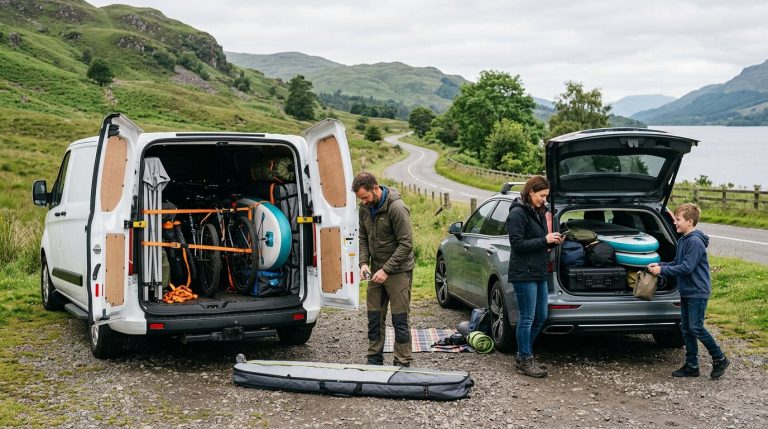
Paddleboards, bikes, golf clubs, a tripod and hard camera cases, a folding gazebo: hobbies take up space, and a holiday is when all of it comes out at once. Anyone who travels with photography gear knows the problem well. A long tripod and a padded lens case don’t stack neatly with everyone else’s luggage, and neither should end up under a pile of bags. If your trip carries on from the Lakes into Scotland, the vehicle question gets sharper. Do you need a car with a decent boot, or do you need proper cargo space?
The quick test is this. If everything fits in a car with the people, you need a car. If the kit pushes someone out of a seat, or won’t fit without dismantling half of it, you’re in van territory, and the plan changes, because a van carries things, not passengers. People ride in the cab seats only. The load area is for cargo.
The two scenarios below show how that test plays out in practice. They’re hypothetical, set in two different parts of Scotland, and they aren’t meant as one trip.
Measure before you choose
Most hire mistakes happen because nobody measured. Before you look at a single vehicle, get the tape out.
- Longest item. A paddleboard, a tandem or a set of tent poles decides more than total volume does.
- Heaviest single item. If it takes two people to lift at home, it’ll take two people at the other end.
- Things that mustn’t be stacked. Camera cases, model layouts, anything with a screen.
- Who’s travelling. Count heads against seats, not against floor space.
Then work out the weight, roughly. A standard car licence (category B) covers vehicles up to 3,500kg maximum authorised mass for petrol, diesel and hybrid models, according to GOV.UK. Most standard panel vans are plated at or below that. Bigger box vans can sit close to the limit, so ask the hirer for the plated weight of the exact vehicle.
Scenario one: a van for the kit near Helensburgh
A hypothetical family of four are spending a week in a rented house near Helensburgh, on the Firth of Clyde, after a few days in Cumbria. They’ve driven up in a small hatchback. Between them they own two inflatable paddleboards, three bikes, a gazebo and the usual camping clutter for days by the water. On the drive north, the car was full to the roof.
For the middle of the week they plan a couple of days out with all the gear. Rather than load the hatchback every morning, they look at a small van for two days. The parents agree that one of them drives the van with the kit and the other follows in the car with the children. Nobody travels in the back of the van.
They use the Helensburgh hire enquiry page, which lists vans from a compact Caddy up to Luton box vans with tail lifts. The page is written mainly for trade and business users, so their first question is whether it hires to private customers for leisure. After that they ask about load length, whether bikes can be strapped inside, and whether the van has tie-down points.
If their days out involve camping by Loch Lomond, they also check the national park authority’s camping permit page, because some lochshore areas need a permit for tents, motorhomes and campervans in season.
Scenario two: a car with room for clubs in Leven
A different hypothetical pair, two friends on a golfing break, are staying in Leven on the Fife coast. They arrive without a car. All they need is something to carry two people, two golf bags and two trolleys between their accommodation and the courses along the coast.
That’s a car job, not a van job. An estate or a larger hatchback with the rear seats up should take the bags, but they still measure the bags and folded trolleys before booking, because some boots are wider than they’re deep.
They enquire about car hire in Leven. The page lists cars including estate models, and says vehicles are delivered and collected from a depot in Glenrothes. The friends ask for the boot dimensions of the car they’d actually be given, where it would be handed over, and what time it has to be ready for collection on their last morning.
One point on both enquiries: the two hire websites show the same phone number, so they may be part of one network. Treat them as two separate enquiry routes for two separate places, not as competing local firms.
Loading it so it stays put
Whatever you hire, the load is your responsibility once you drive off. The Highway Code (rule 98) says you must not overload a vehicle, must secure the load, and it must not stick out dangerously. In practice:
- Bring your own ratchet straps rather than assuming the hirer will supply them. Bungee cords aren’t a substitute for proper straps on anything heavy.
- Put heavy items low and against the bulkhead, not loose at the back doors.
- In a car, keep anything heavy off the parcel shelf and out of the cabin.
- Bikes inside a van travel best upright and strapped to a side rail, or flat with wheels removed and padded.
Shared measurement and booking checklist
Use this for either scenario, or for your own.
Before you enquire
- Longest item: ______ cm. Heaviest item: ______ kg (rough).
- Number of people travelling: ______. Seats needed: ______.
- Car or van? (Van only if the kit won’t fit with everyone seated.)
- Days you actually need the vehicle, not the whole holiday.
Questions to ask the hirer
- Do you hire to private customers for leisure use?
- Internal load length, or boot depth and width, of the specific vehicle.
- Are there tie-down points? Is a roof rack or tow bar allowed?
- Handover point, collection time and what happens if you’re late back.
- Documents needed, deposit, insurance excess, and whether your belongings are covered.
On the day
- Walk round the vehicle and photograph any existing damage and the fuel gauge.
- Load heavy first, fragile last, strap everything.
- Check the load again after the first few miles.
At the return
- Empty every corner of the load area or boot. Sand and grass come out now, not later.
- Return the fuel to the agreed level and photograph it.
Two needs, two vehicles, one rule
The two scenarios point in opposite directions, and that’s the point. The family by the Clyde needed somewhere to put things. The golfers in Fife needed somewhere to sit with their things in the boot. Start with the tape measure and a head count, and the right vehicle usually picks itself.